TL;DR — I did a hot sauce making course at Easton Chilli in Bristol. Came home with eight bottles and a new appreciation for the art and science behind it.
Why I signed up Link to heading
I like hot sauce. I go through bottles faster than I’d care to admit, but making my own had never crossed my mind. My partner got me an Easton Chilli course for Christmas. It got rescheduled once, then I sat on it for months before booking. Four months later, I finally went.
My go-to sauces are Black Mamba Habanero Chilli Sauce (Swazi, fruity, habanero-based), Lao Gan Ma (the crispy chilli oil that goes on everything), and Cholula (solid everyday hot sauce). Black Mamba was the one I wanted to try recreating.
I expected it to be all flavour talk, and a lot of it was. But the part that surprised me was how much of hot sauce production is about food safety: making something that won’t kill anyone.
The recipe Link to heading
I mixed up my reference. I’d been thinking of Swazi Fire, a chunkier, oil-based chilli sauce with no citrus at all. Different brand, different profile. I realised the mix-up after the course, but the recipe we built landed closer to the Black Mamba anyway: citrus, vinegar, and smooth-blended peppers.
The instructor talked about flavour in terms of time. Some ingredients hit you straight away (vinegar, citrus), others build over a few seconds (garlic, ginger), and the chilli heat has its own delayed curve on top of all of that. You’re layering a sequence.
We started by sweating down onions and shallots with garlic and ginger, then adding bell peppers, scotch bonnets, and a Carolina reaper. Blood oranges went in for sweetness and acidity. Korean red pepper flakes added depth and colour.
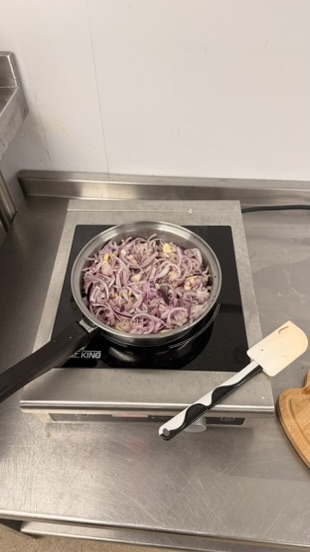
The full ingredient list:
- 1 onion, 5 shallots, 4 bulbs of garlic
- 1 thumb of ginger
- 2 bell peppers, 10 scotch bonnets, 1 Carolina reaper
- 4 blood oranges
- 4 teaspoons of Korean red pepper flakes
- 3 teaspoons of salt, 4 tablespoons of sugar
- 200ml hibiscus kombucha vinegar (sweet, not sharp like white vinegar)
I also learned that the heat in a chilli comes from capsaicin, and most of it sits in the placenta, the white pith inside the pepper that holds the seeds. The seeds aren’t hot; they pick up capsaicin from touching the membrane. Scrape out the pith and the heat drops off. We left it all in.
Once everything was soft, the whole lot went into a blender and got pulsed smooth.
The pH threshold Link to heading
This is where it stopped feeling like a cooking class. The number that matters is pH 4.6. Below that, the acidity prevents Clostridium botulinum from producing toxin. Above it, your sauce is a botulism risk.
You test with pH strips or a digital meter after blending. Our batch came in at around pH 4, well under the threshold thanks to the vinegar and citrus. But the instructor was clear: if it doesn’t, you add more acid until it does. No exceptions. The vinegar is there as a preservative.
Pickles, kimchi, and fermented hot sauces stay safe the same way. Enough acid, and bacteria can’t grow.
Pasteurisation Link to heading
After blending, the sauce needs to hit at least 82°C, ideally a full rolling boil at 100°C. This kills bacteria already present. pH alone prevents new growth; pasteurisation handles what’s in there. You need both to pass.
Bottling Link to heading
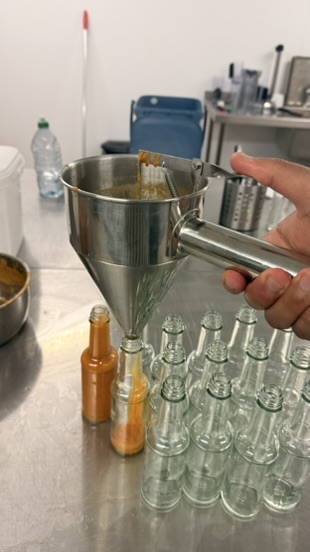
You sterilise the bottles separately, then pour the sauce in hot through a metal funnel. Fill to the brim and cap straight away. As it cools, the temperature drop pulls the lid tight into a vacuum seal. The instructor said a properly sealed bottle with pH under 4.6 should last around 18 months at room temperature.
The result Link to heading
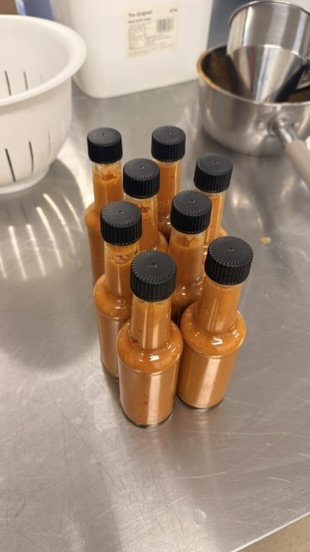
Eight bottles of fruity, face-melting sauce. The scotch bonnets bring a sustained heat, the reaper kicks in a few seconds later, and the blood orange rounds it out. The Korean red pepper flakes add something that straight chilli powder doesn’t.
We also sampled a range of Easton Chilli’s own sauces during the course, from mild fruity ones to some painful fermented varieties.
Finished the evening with samosas from Jeevan’s Sweets down the road. I’d recommend both.
Further reading Link to heading
- Easton Chilli — the course I did, based in Bristol
- FDA guidance on acidified foods — the science behind the pH 4.6 threshold
- Jeevan’s Sweets — excellent samosas