TL;DR: I thought there was. There isn’t, unless there’s a tailwind. In vertical rain, faster is always drier.
Motivation Link to heading
I was cycling home yesterday in heavy rain and started wondering about the right speed. Slower means more time getting drizzled on. Faster means more rain per second on my front. It felt like there had to be a sweet spot.
The setup Link to heading
Picture rain falling at speed $v_r$, with $\rho$ drops per cubic metre. I cycle at speed $v$ over distance $D$. Let $A_t$ be the area of my head and shoulders (top), and $A_f$ the area of my chest (front).
Two surfaces collect rain.
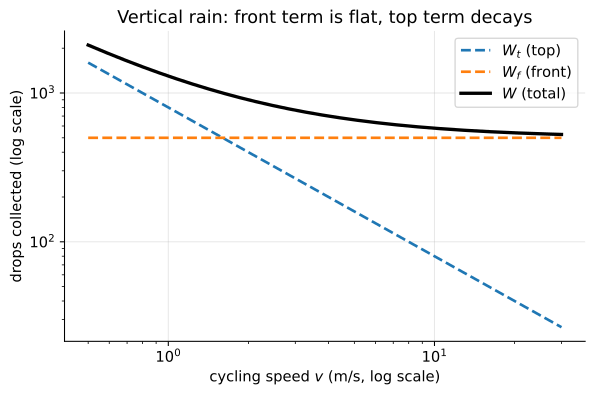
The top of my head catches drops at a rate that depends on how fast they fall and how much surface I’m offering. I’m out for time $D/v$. Total drops on top:
$$ W_t = A_t \cdot \rho \cdot v_r \cdot D / v $$
This shrinks as I go faster. Less time exposed, less rain.
My chest ploughs through rain hanging in the air. Per second I push into a column of volume $A_f \cdot v$. Each cubic metre has $\rho$ drops, so the rate of front-strikes is $A_f \cdot v \cdot \rho$. Time is $D/v$. Total:
$$ W_f = A_f \cdot \rho \cdot v \cdot D / v = A_f \cdot \rho \cdot D $$
The $v$ cancels. Front-wetness is independent of speed.
Total wetness:
$$ W(v) = A_f \cdot \rho \cdot D + A_t \cdot \rho \cdot v_r \cdot D / v $$
This decreases as $v$ grows. Faster is drier. No optimum.
Where my intuition broke Link to heading
The intuition “going faster means hitting more rain per second on my front” is correct as a rate. But you also spend fewer seconds covering the same distance, and the two effects cancel.
Imagine you could freeze the rain mid-air, like a 3D speckle pattern of suspended drops. Now walk through it. The number of drops you collide with depends only on the volume your body sweeps out: frontal area times distance. Speed doesn’t enter.
$$ \text{drops on front} = A_f \cdot D \cdot \rho $$
Distance is fixed. You’re going home, not running laps. So the front term is fixed too.
Unfreeze the rain and nothing changes for the front face. The rain is in steady state. As drops fall away, new ones replace them from above. Density in the tube ahead stays the same.
Speed only matters for the top of your head, because rain lands on it at a fixed rate regardless of how you move horizontally.
Adding wind, or rain at an angle Link to heading
“Rain at an angle” is the same problem as “vertical rain plus horizontal wind”. The rain has a downward component $v_r$ and a horizontal component $v_w$, and the angle is $\tan\theta = v_w / v_r$.
In your moving frame, the rain has horizontal velocity $v_w - v$. The front-strike rate becomes:
$$ A_f \cdot \rho \cdot |v_w - v| $$
Total wetness:
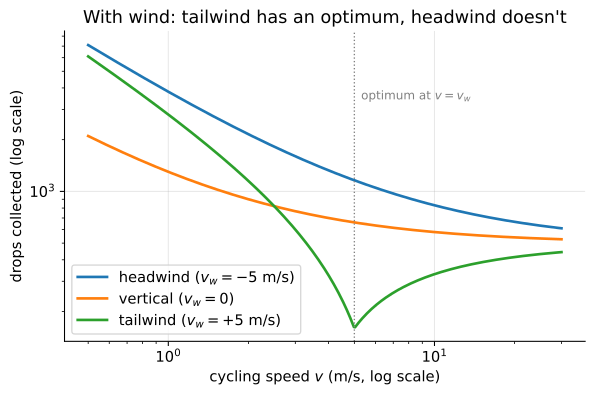
$$ W(v) = (D / v) \cdot \rho \cdot ( A_t \cdot v_r + A_f \cdot |v_w - v| ) $$
Three regimes.
Headwind ($v_w < 0$, rain blowing toward you). The front term grows with $v$, but the time term $D/v$ shrinks faster. Faster still wins.
Tailwind ($v_w > 0$). If you match the wind speed, $v = v_w$, the front term vanishes. In your frame the rain falls vertically and only the top of your head gets wet. That’s the optimum.
Pure vertical rain. Special case with $v_w = 0$. Faster is better, asymptoting to $A_f \cdot \rho \cdot D$.
There’s also an apparent-angle effect that explains the sensation of rain in your face. Even in vertical rain, when you cycle forward the rain looks like it’s coming at you at an angle:
$$ \tan\theta_a = v / v_r $$
At cycling speed (~5 m/s) through rain (terminal velocity 6-9 m/s), the apparent angle is 30-40° off vertical. That feels like more rain on your front. It isn’t, in total, for the reasons above.
Round trips and the Bristol case Link to heading
I cycle in Bristol. It rains a lot here, including in May, and the city sits in the path of westerlies coming off the Atlantic, so there’s almost always some wind. A there-and-back commute has a tailwind one way and a headwind the other. The asymmetry doesn’t cancel.
On the tailwind leg, you cruise at $v = v_w$ (assuming you can match it) and only the top of your head gets wet. Front term is zero. On the headwind leg, you ride flat-out, take the full $A_f \cdot \rho \cdot D$ on your chest, plus an amplification of $(1 + v_w / v_{\max})$ because the rain is now flying at you faster.
Comparing the round-trip wetness in steady wind against the still-air case:
- Light breeze ($v_w < v_{\max}$, the typical Bristol day): the tailwind savings on chest hits beat the headwind cost. The round trip is drier than no wind at all.
- Matching wind ($v_w = v_{\max}$): the savings cancel the cost. Round-trip wetness equals the still case.
- Storm ($v_w > v_{\max}$): you can’t catch the tailwind, so it stops being free. The headwind leg amplifies. The round trip is much wetter than no wind.
A steady gentle breeze helps you on a round trip. A storm punishes you on both legs. In typical Bristol conditions, the wind tends to net out as a small win, and the answer holds: pedal hard.
Pushing the limits to the speed of light Link to heading
Take the total wetness $W(v) = A_f \cdot \rho \cdot D + A_t \cdot \rho \cdot v_r \cdot D / v$. The top term goes to zero as $v$ grows. The front term is a constant. As $v \to \infty$, total wetness asymptotes to $A_f \cdot \rho \cdot D$.
The regimes look like this on a log-log plot:
- Walking (~1.4 m/s): top and front terms comparable.
- Cycling (~5 m/s): top about half the front term.
- Motorbike (~30 m/s): top term ten times smaller than the front, near the asymptote.
- Speed of light (3 × 10⁸ m/s): top term vanishes. Front term unchanged. You collide with the drops in the tube, which are now relativistic projectiles, and you’re vaporised.
Adding relativity puts a $1/\gamma$ factor on the top term from time dilation, which only makes it shrink faster. The front term $A_f \cdot \rho \cdot D$ counts drops in a fixed volume of space, and that count is invariant. The same drops hit you whether you cross the tube in an hour or a microsecond.
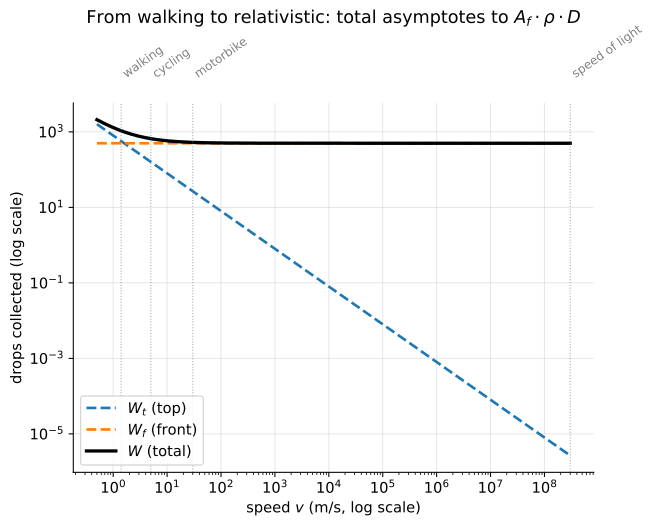
Going faster than a motorbike yields almost nothing in dryness terms. You’ve already converged on the floor of $A_f \cdot \rho \cdot D$ drops, and the only remaining variable is how violently those drops arrive.
Other people who’ve thought about this Link to heading
It’s a well-trodden problem.
- Alessandro De Angelis, “Is it really worth running in the rain?”, European Journal of Physics (1987). The canonical academic version.
- Trevor Wallis and Thomas Peterson at NOAA actually ran the experiment in identical sweatsuits, weighed before and after. The runner came back about 40% drier.
- Mythbusters tested it twice. First episode said walking was better, second flipped to running.
- Franco Bocci, “Whether or not to run in the rain”, European Journal of Physics (2012). Generalises to 3D with arbitrary wind direction. Best treatment I’ve found.
What I’ll do next time Link to heading
Pedal hard. The “more rain per second” effect doesn’t punish me, because I’m spending less time in it. The only term that depends on speed is the rain landing on my head, and that one rewards going faster.
The exception is a tailwind, where the optimum is to match the wind. In practice no one can pace a 30 mph squall, so the answer reduces to: go fast.
Further reading Link to heading
- De Angelis (1987), original physics paper
- Bocci (2012), 3D treatment with wind
- Wallis and Peterson, NOAA experiment
- Plot script (gist) used to generate the figures in this post